The Rise of Micro and Nano Influencers: Why Smaller Is Becoming Better in 2026
In the ever-evolving landscape of digital marketing, a significant shift is underway. While celebrity endorsements and mega-influencers once dominated brand partnerships, a new breed of content creators is proving that when it comes to authentic engagement and meaningful connections, smaller is often better. Micro and nano influencers are revolutionizing the way brands connect with audiences—and the data backs up their growing dominance.
Understanding the Influence Spectrum
Before diving into why these smaller creators are making such a massive impact, it's essential to understand the classification:
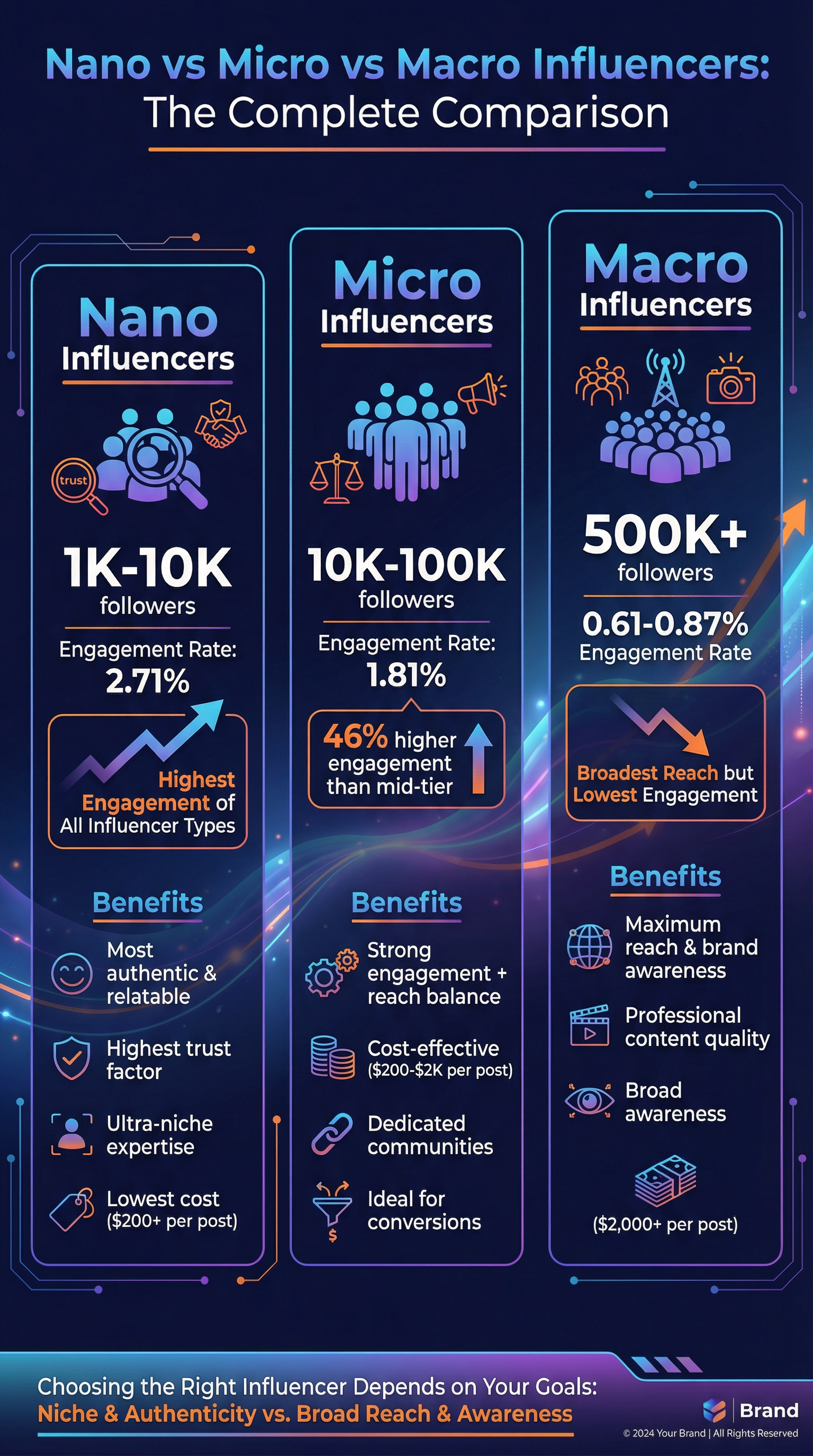
- Nano-influencers: 1,000 to 10,000 followers
- Micro-influencers: 10,000 to 100,000 followers
- Mid-tier influencers: 100,000 to 500,000 followers
- Macro-influencers: 500,000+ followers
- Mega-influencers: 1 million+ followers
The industry has witnessed a dramatic pivot toward the lower end of this spectrum, with nearly 70 percent of brands planning to use primarily nano or micro-influencers in 2024—a trend that has only intensified heading into 2026.
The Engagement Advantage: Numbers That Tell a Story
Perhaps the most compelling reason brands are gravitating toward smaller influencers is their exceptional engagement rates. According to comprehensive research analyzing over 17,000 influencer marketing campaigns, the engagement statistics are striking:
- Nano-influencers (1K-10K followers) achieve the highest average engagement rate at 2.71%
- Micro-influencers (10K-50K followers) follow closely with 1.81% engagement
- Mid-tier influencers (50K-100K followers) lag behind at just 1.24% engagement
This means nano-influencers generate 49.7% higher engagement than micro-influencers, while micro-influencers outperform mid-tier creators by an impressive 46%. These engagement rates dwarf those of macro-influencers (0.61%-0.87%) and mega-influencers (0.68%-0.94%), demonstrating that follower count doesn't necessarily translate to meaningful interactions The Social Cat. The global influencer marketing industry has reached $32.55 billion in 2026, with social media becoming the world's largest advertising channel. Within this massive ecosystem, micro-influencers have become the most popular tier, connecting with nearly half of all surveyed audiences Impact.
Why Smaller Influencers Deliver Bigger Results
1. Authenticity and Relatability
The power of nano and micro-influencers lies in their authenticity. Unlike polished celebrity endorsements, these creators showcase real lives and genuine experiences. Their content feels more like a recommendation from a trusted friend than a paid advertisement. Research reveals that 92% of consumers trust micro-influencer recommendations over traditional advertising or celebrity endorsements. This trust translates directly into action—small-scale influencers with thousands of fans drive 60 percent higher campaign engagement rates than those on the macro end of the scale. Consumers, especially Gen Z, increasingly prefer relatable, "friend-like" recommendations from smaller creators over celebrity endorsements. This shift reflects a broader consumer fatigue with overly polished advertising and a demand for values-aligned, authentic content.
2. Budget-Friendly Investment with Lower Risk
Cost-effectiveness is another major advantage. While macro-influencers can charge anywhere from $15,000 to $49,000 per post depending on the platform, nano and micro-influencer pricing can start from as little as $200 per post. This dramatic price difference makes influencer marketing accessible to brands of all sizes. According to HubSpot, 44% of marketers say the largest benefit of working with small influencers is that they're less expensive and easier to establish long-term partnerships with. The lower investment also allows brands to test, learn, and iterate without carrying significant financial risk Impact.
3. Niche Expertise and Targeted Audiences
Micro and nano-influencers often specialize in specific niches, making them ideal for brands targeting particular audiences. Whether it's vegan cooking, sustainable fashion, or financial literacy, these creators have cultivated highly engaged communities around shared interests.The data proves the power of niche alignment: campaigns that match an influencer's niche to the product category see 13.59% higher engagement and 81.39% more views. Yet surprisingly, only 37.20% of brands currently prioritize choosing influencers in the same niche as their product—representing a massive untapped opportunity The Social Cat.
4. Higher Conversion Rates
Beyond engagement metrics, smaller influencers excel at driving actual conversions. Their closer relationships with followers create trust that translates into purchasing decisions. Brands can leverage this through gifted products combined with affiliate links, creating performance-driven partnerships that deliver measurable ROI.
5. The Gifted Collaboration Advantage
An unexpected finding from recent research challenges conventional wisdom about paid partnerships. Gifted collaborations deliver 12.9% more engagement than paid partnerships, achieving a 2.19% engagement rate compared to 1.94% for paid collaborations. The research reveals a clear pattern: nano and micro-influencers respond best to gifted collaborations (2.76% engagement), while mid-tier influencers perform better with paid partnerships. This makes gifted strategies particularly cost-effective for brands working with smaller creators The Social Cat. Among brands running both paid and gifted campaigns, gifted collaborations averaged almost 3 times more views (215% increase) than paid collaborations, making them a highly efficient strategy for maximizing reach and engagement.
Content That Converts: What Works Best
Understanding which content formats drive the best results is crucial for campaign success. Analysis of top-performing campaigns reveals several key insights:
Content Format Matters
- Carousel posts achieve the highest engagement rate at 2.62%
- Single images follow at 2.14%
- Reels deliver 2.03% engagement but excel at driving views (averaging 10,399 views)
Product Integration Over Direct Selling
Content where products are seamlessly integrated (product placement) generates 89.93% more engagement than content that directly advertises. Audiences are less likely to engage when a post's sole purpose is selling—content without direct calls to action showed 70% better engagement than posts with explicit sales pitches The Social Cat.
The Power of Faceless Content
Interestingly, faceless videos tend to outperform videos featuring the influencer on screen. Faceless content averages 46% engagement compared to 32% for videos showing the creator, and receives significantly more views (6 million average versus 1.6 million).
Success Stories: Brands Winning with Micro-Influencers
Leading brands across industries have embraced micro and nano-influencer strategies with impressive results:
- Beauty brands have seen nano-creators become their best marketing tool, with growth concentrated in this segment
- Glossier, Lululemon, HelloFresh, and Airbnb have all successfully built campaigns around micro-influencer partnerships on Instagram
- Daniel Wellington famously grew its brand within three years primarily through micro-influencer collaborations
- Cuts clothing brand recently executed a product seeding campaign with nano and micro-influencers, successfully growing both the creators' social presence and Cuts' brand awareness
These success stories demonstrate that integrating micro-influencers into a holistic marketing strategy can significantly boost brand sales and awareness.
The 2026 Shift: Data-Driven, Long-Term Partnerships
As influencer marketing matures in 2026, the industry is becoming more sophisticated. Two major shifts are defining success:
1. ROI and Performance Focus
With the industry crossing $32 billion, brands demand measurable results. This means tracking metrics like clicks, conversions, and revenue while optimizing campaigns continuously. Analytics dashboards now attribute sales to specific influencer posts, and unique discount codes measure individual impact. The push for ROI extends to strategy—brands prioritize partnerships aligning with target audiences. Performance-driven contracts with specific targets are becoming standard, moving away from vanity metrics toward genuine business outcomes Stack Influence.
2. Long-Term Ambassador Programs
The shift from one-off posts to ongoing collaborations is accelerating. A recent Snapchat study found 45% of mid-tier creators prefer long-term brand partnerships because they enable richer storytelling and better conversion rates. Additionally, 58% of B2B brands now use always-on influencer programs, finding them overwhelmingly effective compared to isolated campaigns. Long-term partnerships allow influencers to develop deeper product knowledge, making promotions feel more organic. This signals to followers that the influencer genuinely uses and believes in the brand—building trust over time Stack Influence.
Best Practices for Working with Micro and Nano-Influencers
To maximize success with smaller creators, brands should follow these evidence-based strategies:
Do:
- Reach out via social media DMs and emails with personalized messages
- Research content thoroughly before approaching creators
- Align with niche influencers whose audiences match your target market
- Specify target audiences in campaigns (campaigns with defined audiences show 20.92% higher engagement)
- Embrace gifted collaborations for nano and micro-influencers
- Think long-term with 6-12 month partnerships for better ROI
Don't:
- Contact influencers via comments or use generic outreach
- Incorrectly address creators or show lack of familiarity with their work
- Expect immediate results—building authentic partnerships takes time
- Obsess over follower counts—engagement and alignment matter more
- Overlook niche alignment—it's a massive performance differentiator
The Future Is Micro
The data is conclusive: micro and nano-influencers aren't just a trend—they're the future of effective influencer marketing. Their authenticity resonates with audiences weary of polished advertisements, their engagement rates far exceed larger creators, and their cost-effectiveness makes influencer marketing accessible to brands of all sizes. As one marketing expert noted, "It's not about size, it's about connection. Nano and micro-influencers are the real engagement drivers. For businesses aiming to build trust and drive meaningful interactions, they're the secret weapon for authentic interactions and budget-friendly wins. "In 2026 and beyond, smart brands will continue shifting budgets toward these smaller creators, building long-term partnerships, tracking performance rigorously, and prioritizing authentic connections over reach metrics. The era of the micro-influencer has arrived—and it's delivering macro results.